
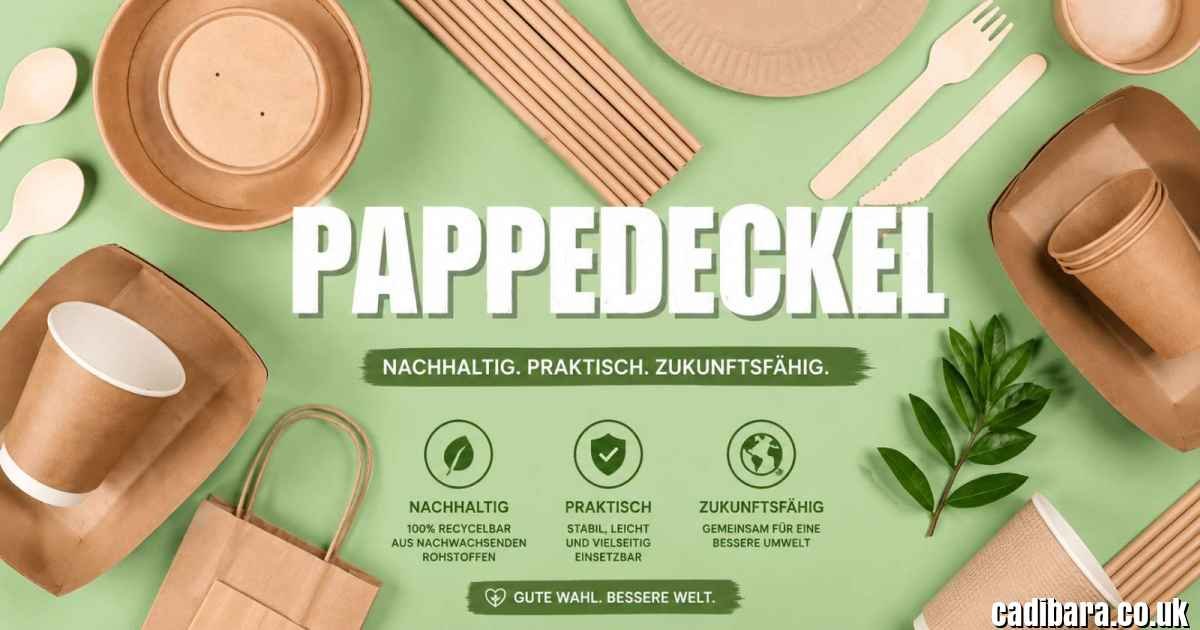
Pappedeckel is becoming an increasingly interesting term in the world of sustainable packaging, particularly across food service, hospitality, retail, and beverage businesses. The German word combines Pappe, meaning cardboard or paperboard, with Deckel, meaning lid or cover. In practical terms, it can describe a cardboard lid, paperboard cover, or coaster, depending on the context.
In 2026, businesses are looking for packaging that can balance functionality, food safety, branding, cost, and environmental responsibility. That is where paper-based packaging can offer an alternative to conventional plastic components. Coffee cups, takeaway containers, dessert tubs, food bowls, jars, and promotional coasters can all use paperboard formats when the material and design are appropriate.
This complete guide explains what Pappedeckel means, how it is manufactured, its major types and applications, its sustainability advantages and limitations, how it compares with plastic and bioplastic alternatives, and what businesses should consider before buying it.
What Is Pappedeckel? Meaning and Origin
The word Pappedeckel comes from German. Pappe generally refers to cardboard or paperboard, while Deckel means lid, cover, or cap. The literal interpretation is therefore cardboard lid. The exact product represented by the term depends on where and how it is used.
A Pappedeckel can be manufactured from paperboard, recycled fibers, virgin kraft board, molded fiber, or other cellulose-based materials. Its shape may be flat and circular, or it can be engineered with folds, rims, tabs, openings, and formed edges to suit a particular container. Applications include takeaway cups, soup bowls, ice cream containers, food trays, jars, and other packaging formats.
There is also an important cultural meaning. In German-speaking regions, closely related terminology is associated with the familiar Bierdeckel, or beer coaster. These thick cardboard discs absorb condensation and protect tables while also providing a surprisingly useful advertising surface. Modern packaging discussions, however, can use Pappedeckel more broadly for paperboard covers and lids.
One common misconception is that every paperboard lid is automatically biodegradable, recyclable, compostable, or environmentally superior. The reality is more nuanced. Coatings, adhesives, inks, contamination, fiber source, manufacturing energy, and local waste infrastructure all influence environmental performance. A coated paper lid should therefore be evaluated according to its complete material specification rather than its cardboard appearance alone.
How Pappedeckel Is Made: Materials and Manufacturing in 2026
Modern Pappedeckel manufacturing begins with selecting a paperboard suitable for the intended application. Depending on the manufacturer and product, this can include recycled paper fibers, responsibly sourced virgin fiber, kraft board, molded fiber, or agricultural-fiber materials such as bagasse. Certifications such as FSC can help buyers verify responsible forestry claims, while recycled-content documentation can provide additional information about material sourcing.
The fibers are processed into paperboard with the required thickness and strength. For food applications, manufacturers may use different surface treatments to improve resistance to water, grease, heat, and condensation. These treatments can include water-based dispersion coatings, bio-based coatings, or other food-contact-approved barriers. The correct coating is important because a lid designed for a dry product may perform very differently from one intended for hot soup or oily food.
After the board has been prepared, manufacturers use die-cutting, forming, embossing, or precision converting equipment to create the final shape. A cup lid, for example, may require a carefully engineered rim that grips the cup while maintaining the desired opening and preventing unwanted movement. Some designs incorporate a sip opening, foldable tab, vent, or other functional feature.
The final stage can include custom printing and finishing. Businesses may add logos, colors, promotional messages, QR codes, seasonal artwork, or other branding. Food-contact packaging requires appropriate inks, coatings, and production controls, so buyers should always request relevant technical and compliance documentation rather than relying solely on marketing claims.
Types of Pappedeckel Available in 2026
There is no single universal Pappedeckel design. The best format depends on the container, temperature, contents, expected handling, and branding requirements.
Standard round Pappedeckel is a straightforward option for cups and other containers. Different diameters are available, so businesses should measure the actual container rather than assuming that a particular nominal size will fit.
A Pappedeckel with a sip opening is designed for takeaway beverages. It can include a punched opening, fold-back tab, or other drinking feature. This design can improve convenience for customers who want to drink directly from a takeaway cup.
A high-rim or deeper paperboard lid provides additional structure for bowls and containers. It can be useful for products such as soup, noodles, salads, desserts, and other takeaway foods where a simple flat disc may not provide enough containment.
Coated Pappedeckel can provide greater resistance to moisture and grease. However, the term “compostable” should always be checked against the exact product and certification because a coating can affect end-of-life processing.
Finally, custom printed Pappedeckel and beer-coaster formats turn a functional packaging component into a branding asset. Kraft versions can also create a natural appearance that suits organic cafés, artisan food companies, breweries, and businesses positioning themselves around sustainability.
Why Businesses Are Switching to Pappedeckel in 2026
One major attraction is the possibility of reducing reliance on conventional plastic packaging. Paperboard comes from renewable or recycled fiber sources, and suitable products can enter established paper-recycling or composting streams depending on their construction and local infrastructure.
Cost is another consideration. Lightweight packaging can reduce material and transportation requirements, although the actual economics depend on material prices, manufacturing volumes, tooling, coating, printing, freight, and supplier location. Businesses should compare the total delivered cost per unit, rather than assuming that cardboard is always cheaper than plastic.
Branding is particularly interesting. A paperboard surface can function as a miniature billboard. A café can print its logo, a QR code, a loyalty message, or a seasonal campaign directly onto the lid or coaster. When customers carry takeaway drinks through public spaces or photograph them for social media, packaging can become part of the brand experience.
There is also the customer-perception factor. Sustainable-looking packaging can communicate that a business is taking environmental issues seriously. Still, responsible companies should avoid unsupported claims such as “100% eco-friendly” or “zero impact.” Sustainability is a system, not simply a material label.
Pappedeckel vs Plastic Lid vs Bioplastic Lid
| Feature | Pappedeckel | Conventional Plastic Lid | Bioplastic Lid |
|---|---|---|---|
| Typical material | Paperboard or fiber | PP, PET, PS, or other plastics | PLA, CPLA, or related biopolymers |
| Renewable/recycled potential | High, depending on fiber source | Usually low for fossil-based plastic | Potentially high, depending on feedstock |
| Recycling | Often possible, depending on coating and contamination | Depends heavily on local infrastructure | Often limited |
| Compostability | Product-specific | Generally no | Usually requires appropriate industrial conditions |
| Custom printing | Excellent | Possible | Possible |
| Moisture resistance | Depends on coating/design | Generally high | Generally high |
| Typical environmental profile | Can be favorable when responsibly designed | Highly dependent on material and disposal | Depends on feedstock, manufacturing, and end-of-life |
| Best use | Cups, food containers, coasters, packaging | Broad range of applications | Applications requiring molded bioplastic properties |
The important lesson is that no material wins every category automatically. A paperboard lid can have an environmental advantage in one system but perform poorly if it is heavily coated and cannot be recovered locally. Likewise, a bioplastic may be made from renewable feedstocks but still require industrial composting that is unavailable in the customer’s area.
Top Uses of Pappedeckel in 2026
The most visible application is the food and beverage industry. Coffee shops, bakeries, restaurants, fast-food businesses, catering companies, and takeaway brands can use paperboard lids for hot and cold beverages or suitable food containers.
Restaurants and cloud kitchens can use appropriately engineered grease-resistant lids for delivery packaging. The goal is not simply to replace plastic visually; the lid must withstand the actual temperature, moisture, grease, stacking, and transportation conditions involved in delivery.
Breweries, bars, and hospitality businesses have another classic application: the Bierdeckel or beer coaster. Custom coasters can display logos, campaigns, QR codes, event information, or promotional offers while protecting tables from moisture.
Events and trade shows can use custom-printed cardboard discs as inexpensive promotional products. In cosmetics and specialty retail, paperboard inserts and covers can also contribute to an eco-luxury aesthetic for jars, candles, tubes, and gift packaging.
Sustainability and Circular Economy Impact
The strongest argument for Pappedeckel is its potential role in a circular packaging system. Paper fibers can be sourced from responsibly managed forests or recycled materials, converted into products, collected after use, and potentially returned to recycling streams.
Imagine a café serving 500 takeaway drinks every day. Over a year, that represents approximately 182,500 drink occasions. If each requires a disposable lid, the choice of lid material becomes meaningful at scale. Replacing a conventional plastic component with a suitable paper-based alternative can reduce dependence on fossil-derived materials, although the real environmental benefit should be evaluated through the product’s full life cycle.
It is also important to correct a common claim: Pappedeckel should not automatically be described as carbon neutral. A paper product still has emissions associated with forestry or recycled-fiber collection, pulping, manufacturing, coating, printing, transport, and disposal. Carbon neutrality requires a specific accounting methodology and, where applicable, credible reduction and offsetting measures.
Disposal instructions matter just as much. Some products belong in paper recycling, while others may be accepted through organic waste or industrial composting systems. Always follow the manufacturer’s disposal guidance and local waste rules.
How to Choose and Buy the Right Pappedeckel in 2026
Start with size and compatibility. Measure the container’s opening precisely and test samples before placing a large order. A lid that looks close to the correct diameter can still leak, loosen, or fail under real-world conditions.
Next, select the correct material and coating. Hot beverages, oily foods, frozen desserts, and dry products place different demands on packaging. Ask the supplier for technical specifications covering temperature resistance, grease resistance, moisture resistance, food-contact suitability, and shelf life.
Certifications should also be verified rather than assumed. Depending on the market, relevant documentation may include FSC certification, food-contact compliance, compostability certification such as EN 13432 where applicable, and other regional regulatory requirements. FDA-related compliance may be relevant for products sold in the United States, while European businesses need to consider applicable EU food-contact and packaging rules.
For branding, request a physical sample showing the actual printing quality. Compare suppliers on minimum order quantity, printing method, tooling costs, lead time, shipping, packaging, and total landed price. A supplier offering a low unit price may not be the cheapest once freight, setup, and rejected products are included.
Final Verdict: Is Pappedeckel Worth It in 2026?
Pappedeckel represents a useful direction in the continuing shift toward paper-based and fiber-based packaging. Its appeal comes from a combination of renewable or recycled material potential, customization, lightweight construction, and compatibility with the growing demand for alternatives to conventional single-use plastic.
But the smartest purchasing decision is not simply “paper good, plastic bad.” Businesses should examine the entire product: material source, coating, manufacturing, food-contact compliance, performance, recyclability or compostability, transport, and local disposal infrastructure.
For cafés, restaurants, breweries, event organizers, food-delivery businesses, and packaging brands, a well-designed Pappedeckel can be both a functional component and a visible part of the customer experience. Choose the right specification, verify environmental claims, test performance, and provide clear disposal instructions. That approach makes sustainable packaging more credible—and far more useful in the real world.
Frequently Asked Questions
What does Pappedeckel mean?
Pappedeckel is a German term that can literally be understood as a cardboard or paperboard lid. Related terminology can also refer to cardboard drink coasters, especially in the context of beer coasters.
Is Pappedeckel biodegradable?
Some Pappedeckel products are biodegradable or compostable, but not every paperboard lid has the same end-of-life characteristics. Coatings, adhesives, inks, and product construction all matter.
Can Pappedeckel be used for hot coffee?
Yes, specially designed paperboard lids can be used for hot beverages. Buyers should confirm the manufacturer’s temperature, moisture, structural, and food-contact specifications before using a particular product.
Is Pappedeckel recyclable?
Many paperboard products can potentially be recycled, but local recycling rules and the lid’s coatings or contamination can affect acceptance. Always check the manufacturer’s instructions and local waste system.
How do I choose the right Pappedeckel supplier?
Compare material quality, size compatibility, food-contact documentation, certifications, coatings, printing quality, minimum order quantities, delivery times, pricing, and sustainability claims. Request samples before committing to a large production run.
